Crypto Mortgage
Bitcoin Mortgage: Complete Guide for 2026
By Colin McMahon
May 5, 2026 • 7 min read

You have Bitcoin. You want to buy a home. Selling your BTC to fund the purchase feels like the obvious move, but if you have been holding for years and believe in where the price is going, liquidating is a decision you may regret.
That tension is exactly what the bitcoin mortgage was designed to solve.
In 2026, this is no longer a niche product. Milo has originated over $100 million in bitcoin-backed home loans, including a single $12 million transaction. Better and Coinbase launched a token-backed conforming mortgage. 52 million American adults, roughly 20% of the country, have owned digital assets at some point, according to recent data.
The market has moved from "interesting experiment" to a real, usable product, and the rules of the game have shifted. This guide covers everything you need to know: how bitcoin mortgages work, what collateral requirements look like, how rates compare, and what changed in 2026 that makes this a different landscape than the year before.
What Is a Bitcoin Mortgage?
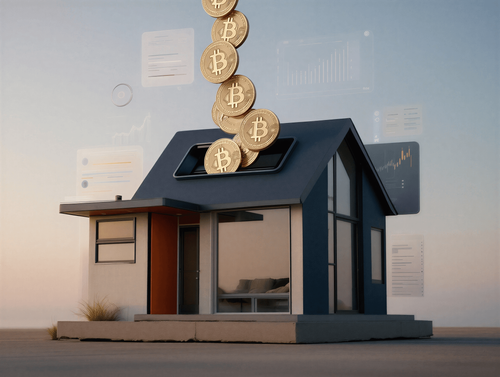
A bitcoin mortgage is a home loan where you pledge Bitcoin as collateral rather than making a traditional cash down payment or liquidating your holdings. You keep ownership of your BTC throughout the loan term. The lender holds it as security.
This is meaningfully different from a crypto-assisted mortgage, where a lender simply allows you to use crypto sale proceeds as verified funds for a down payment. With a true bitcoin mortgage, the crypto itself serves as the collateral for the loan. You do not sell. You do not trigger a taxable event. You pledge.
Lenders evaluate the loan using the value of your pledged crypto rather than a traditional credit score or income history. That makes bitcoin mortgages accessible to a segment of borrowers who hold significant wealth in digital assets but do not show it on a W-2.
How a Bitcoin Mortgage Works in 2026
Apply and pledge collateral. You apply with a lender, pledge your Bitcoin (or Ethereum, or USDC), and the lender evaluates the loan-to-value ratio. With Milo, you can finance up to 100% of the property's value by pledging equivalent BTC collateral. There is no separate down payment requirement if your pledged crypto equals the loan amount.
The collateral is held in custody. Your pledged Bitcoin is held by the lender for the duration of the loan. You do not retain trading access to it, but you also do not trigger a taxable event. You are borrowing against your Bitcoin, not selling it.
You make monthly mortgage payments. Like any mortgage, you pay each month. With Milo, the loan has a 30 year term.
What happens if Bitcoin's price drops. Here is how it works in practice: when you pledge Bitcoin as collateral, the lender monitors the ratio between your collateral value and your outstanding loan. If Bitcoin's price falls far enough that the collateral no longer adequately covers the loan, the lender issues a margin call. At that point, you can respond by adding more collateral, making a partial paydown on the loan, or a combination of both.
With Milo, the margin call threshold is set at a 65% decrease in Bitcoin's value from the time of origination. That is a substantial buffer. Bitcoin would need to lose nearly two thirds of its value before a margin call is triggered. For context, even during Bitcoin's most significant drawdowns, including the 2022 cycle low, prices fell roughly 75% from their all-time high over the course of more than a year, not overnight.
Importantly, Milo has never issued a margin call on its mortgage product. The 65% threshold has not been breached by any borrower since the product launched. That track record reflects both the size of the buffer built into the structure and the profile of borrowers who have used it.
Bitcoin Mortgage vs. Selling Your BTC: What the Math Actually Shows
For most crypto holders, the question is not whether a bitcoin mortgage is possible. It is whether pledging makes more financial sense than selling.
Consider this: you hold $500,000 in Bitcoin and want to buy a $500,000 home.
If you sell, you trigger capital gains tax on any appreciation. Federal long-term capital gains rates run between 15% and 20% for most taxpayers, with state taxes adding more in many places. You also exit your Bitcoin position entirely. Any future price appreciation benefits someone else.
If you pledge instead, you keep your BTC exposure intact, pay a mortgage rate (Milo's rates run 6.5% to 8.5% APR depending on structure), and continue to benefit from any appreciation during the loan term.
The math favors pledging when your expected long-term Bitcoin appreciation exceeds the mortgage interest cost. It does not favor pledging in every situation, and interest costs are real. But for a holder who built their BTC position over years, the tax cost of liquidation alone often exceeds one to two years of mortgage interest. That calculus is worth running before making a decision. You can run the calculation with our mortgage comparison tool.
What Changed in 2026
Three developments make the bitcoin mortgage market in 2026 meaningfully different from prior years.
Better and Coinbase launched the first conforming token-backed mortgage. In March 2026, Better Home and Finance partnered with Coinbase to offer mortgages where borrowers can pledge Bitcoin and USDC as collateral. You still have to qualify with traditional income, and loan amounts are capped, but this is a significant institutional signal for the category.
Milo crossed $100 million in originated loans. Milo hit this milestone in early 2026, including a single $12 million bitcoin-backed transaction. That is a meaningful proof point that the product works across a range of property values and borrower profiles, not just early adopters on small purchases.
SpaceX disclosed 18,712 BTC in its S-1 IPO filing. In May 2026, SpaceX's filing revealed holdings worth $1.45 billion, more than double what outside analysts had estimated. The company has held, not sold, since acquiring the position in 2021. For individual bitcoin holders, that institutional signal reinforces the pledge-not-sell approach at the highest level. See: Corporate Bitcoin Treasury: The SpaceX Signal You Shouldn't Miss.
Together, these developments reflect a market that is scaling and attracting mainstream participants. For borrowers, that means more options, more precedent, and a clearer regulatory path than existed two years ago.
How Milo's Bitcoin Mortgage Works
Milo is the most established bitcoin mortgage lender in the U.S. market. Here is how the product works in practice.
You can borrow between $200,000 and $25 million, collateralized by Bitcoin or Ethereum. The loan is a 30-year mortgage. Milo offers up to 100% loan-to-value financing, meaning you do not need a cash down payment if your crypto collateral equals the loan amount.
We qualify you based on your crypto assets rather than your W2 salary, which opens up options to more digital asset holders. Rates run between 6.5% and 8.5% APR depending on credit score and loan structure. If Bitcoin drops in value, Milo has clearly defined liquidation thresholds and a servicing portal that lets you monitor your loan health. Borrowers understand their exposure from the start.
The application process is online. Most borrowers can complete the initial application in under 15 minutes, and Milo handles the full mortgage process from underwriting to closing.
Ready to Explore a Bitcoin Mortgage?
A bitcoin mortgage is not the right product for every buyer. It works best for crypto holders who want to purchase a home without liquidating a long-held BTC position, who prefer to preserve their exposure, and who want a 30-year loan structure with predictable terms. We also have flexible underwriting that is tailored to Bitcoiners rather than trying to squeeze crypto holders into the traditional mortgage box.
If that describes your situation, Milo has the most direct path to getting it done. Over $100 million in originated loans, no down payment required, and a process built for crypto holders from the ground up.
Visit milo.io to learn more or start an application.
The opinions expressed in the Blog are for general informational purposes only and are not intended to provide specific advice or recommendations for any individual or on any specific security or investment product.
Author

Colin McMahon
Senior Manager, Loan Origination
Subscribe to our newsletter
Actual crypto success stories and strategies straight to your inbox.
Related articles

Crypto Mortgage
Bitcoin Backed Mortgage: The Complete Lender Comparison for 2026
By Colin McMahon
August 27, 2026 • 8 min read

Crypto Mortgage
Why Bitcoin Holders Are Buying Homes Without Selling Their BTC
By Colin McMahon
April 9, 2026 • 6 min read
Crypto Mortgage
How Much BTC Do You Need? A Guide to Milo's Crypto Mortgage Loan
By Colin McMahon
March 10, 2026 • 5 min read